The Enigmatic Legacy of Steve McQueen and His 1957 Jaguar XKSS
Driving the legend’s iconic machine through the Hollywood Hills reveals the enduring mystique of the “King of Cool” and his most cherished possession.
Decades after his passing, the name Steve McQueen still evokes a powerful blend of raw charisma, troubled intensity, and a singular passion for speed. He was a complex figure—a contradictory soul who could charm with a disarming smile one moment and seethe with a volatile temper the next. This mercurial nature, coupled with undeniable talent, cemented his status as a cultural icon whose legend only seems to grow richer with time. While his on-screen performances captivated millions, it was his off-screen obsession with automobiles and motorcycles that truly defined his restless spirit. Among the pantheon of machines that passed through his hands, one stands out as a testament to his discerning taste and rebellious soul: the 1957 Jaguar XKSS.
The allure of McQueen’s automotive pursuits is deeply intertwined with his on-screen persona. From the high-octane thrills of Bullitt to the gritty realism of Le Mans, cars were not merely props but extensions of his own identity. He was a man who understood the raw, visceral connection between driver and machine, and he sought that connection in every vehicle he owned. The XKSS, a road-legal descendant of Jaguar’s legendary D-Type race car, represented the pinnacle of this pursuit—a perfect marriage of race-bred engineering and street-legal refinement. To drive this car is to step back into a golden era of motorsport, to feel the very essence of the legend who once called it his own.
The Genesis of a Legend: The Jaguar D-Type and the Birth of the XKSS
To fully appreciate the significance of McQueen’s XKSS, one must first understand the remarkable lineage from which it sprang. In the competitive crucible of 1950s motorsport, Jaguar emerged as a dominant force, challenging the likes of Ferrari and Aston Martin with its innovative and devastatingly effective racing machines. The crown jewel of Jaguar’s efforts was the D-Type, a purpose-built sports racer that would carve its name into the annals of motorsport history.
Conceived in the early 1950s, the D-Type was the brainchild of Sir William Lyons and his brilliant chief designer, Malcolm Sayer. Sayer, a pioneer in aerodynamic research, drew inspiration from the aviation industry to create a body of unprecedented efficiency. The result was a sleek, curvaceous silhouette that seemed to flow over the chassis, its lines honed to slice through the air with minimal resistance. Beneath this breathtaking skin lay a revolutionary construction method. Eschewing traditional body-on-frame construction, Sayer employed a monocoque tub for the cockpit and rear suspension, fabricated from lightweight aluminum alloy. This structural innovation provided exceptional rigidity while keeping weight to a minimum—a critical advantage in endurance racing.
Powering this marvel was Jaguar’s legendary XK inline-six engine, a powerplant renowned for its smooth delivery and impressive output. In the D-Type, the 3.4-liter iteration of this engine was tuned to produce approximately 250 horsepower, a formidable figure for the era. This power was harnessed through a robust four-speed manual transmission, and the car was equipped with cutting-edge technology such as Dunlop disc brakes and a sophisticated independent front suspension system. The D-Type was not merely a fast car; it was a masterpiece of engineering, a testament to Jaguar’s commitment to performance and innovation.
The D-Type’s racing pedigree was nothing short of spectacular. Debuting in 1954, it quickly established itself as the car to beat in international sports car racing. The crowning achievement came in 1955 when a privately entered Ecurie Ecosse D-Type, driven by Ron Flockhart and Ninian Sanderson, swept to victory at the prestigious 24 Hours of Le Mans. This triumph marked the first of three consecutive Le Mans wins for the D-Type, a feat that cemented its legendary status. Throughout the mid-to-late 1950s, the D-Type dominated circuits across Europe and North America, accumulating victories at Spa, the Nürburgring, and Sebring. It was the ultimate expression of sports car racing, a machine that combined brute force with elegant refinement.
The Evolution to the XKSS: A Race Car for the Road
As the 1950s drew to a close, the landscape of motorsport began to shift. Stricter regulations regarding engine displacement and safety concerns led to a gradual phasing out of the D-Type in its purest form. Jaguar, recognizing the changing tide, sought to capitalize on the goodwill and engineering prowess embodied by the D-Type. The solution was a daring and innovative one: to transform the world’s most successful sports racer into a limited-production road car. Thus, the Jaguar XKSS was born.
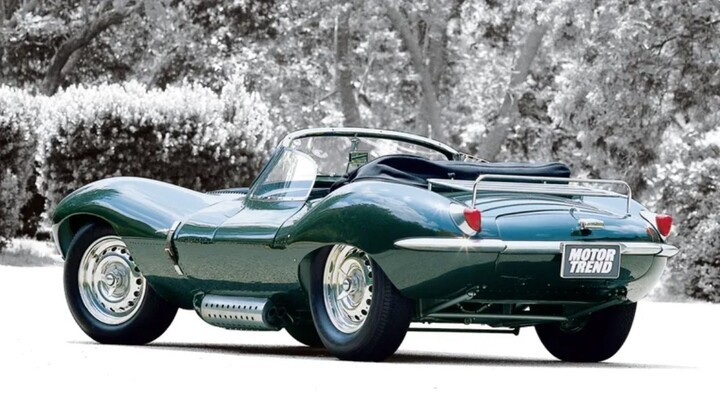
The conversion process was a testament to the resourcefulness of Jaguar’s engineers. The D-Type’s stark, open-cockpit design, optimized for Le Mans, required significant modification to meet road-going standards. The most obvious addition was a full-width windshield, replacing the minimal aero screens of the race car. A collapsible soft top was fitted, offering rudimentary protection from the elements, though its effectiveness was often debated. To address the need for luggage space—a necessity for any road-legal vehicle—a compact rack was affixed to the rear deck, just ahead of the iconic dorsal fin.
Practical concessions were made throughout the design. Side curtains of clear plastic were crafted to fill the open sides of the cockpit, providing a modicum of weather protection. The racing exhaust system, which ran exposed along the driver’s side, was rerouted beneath the car, though exhaust heat remained a persistent issue, leading to the infamous “singed calf syndrome” among owners. Interior appointments were upgraded to a level befitting a luxury sports car. The sparse, utilitarian seating was replaced with plush, upholstered bucket seats, and a passenger-side door was added for the first time. The dashboard, once a spartan affair, was adorned with a full complement of Smiths gauges, their classic typography and chrome bezels radiating an aura of sporting sophistication.
The mechanical heart of the XKSS remained the mighty D-Type engine, though often in a slightly detuned state to ensure reliability in road use. The 3.4-liter XK inline-six, still producing upwards of 250 horsepower, was a potent performer by any standard. Coupled with the D-Type’s lightweight construction—weighing in at just over 2,000 pounds—the XKSS possessed performance capabilities that far outstripped contemporary road cars. Its acceleration was ferocious, its handling razor-sharp, and its top speed capable of embarrassing most sports cars of the era.
Despite the modifications, the XKSS retained the essential character of its racing progenitor. The monocoque chassis provided exceptional rigidity, lending the car a planted and confident feel on the road. The rack-and-pinion steering, direct and communicative, offered a level of feedback that is rare in modern automobiles. The powerful disc brakes, a rarity in the 1950s, provided authoritative stopping power. In essence, the XKSS was a race car wearing a coat of civility—a machine that demanded respect from its driver while rewarding them with an intoxicating blend of speed and refinement.
Production of the XKSS was tragically brief. A catastrophic fire at the Jaguar factory in early 1957 destroyed several unfinished chassis, halting the program prematurely. In total, only 16 production XKSS models were completed, making it one of the rarest and most coveted Jaguars ever produced. This exclusivity, combined with its unparalleled racing pedigree and Steve McQueen’s personal connection, has elevated the XKSS to near-mythical status in the world of automotive collecting.
Steve McQueen and the Green Rat: A Legendary Partnership
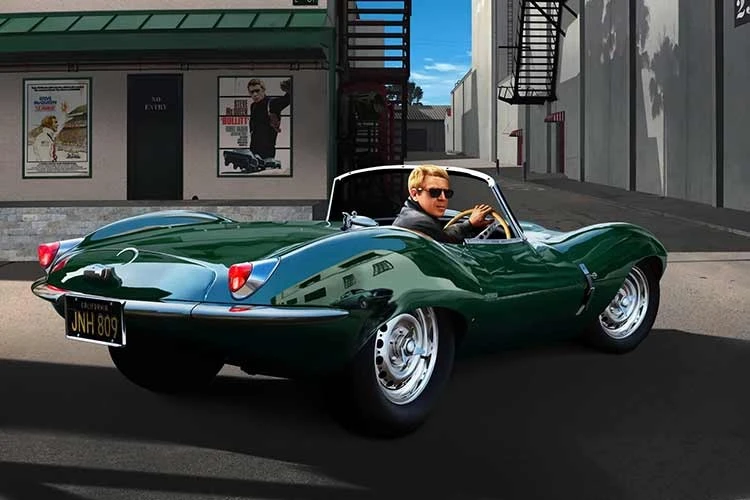
The story of Steve McQueen and his 1957 Jaguar XKSS is the stuff of legend, a tale of a restless spirit finding its perfect mechanical counterpart. McQueen, already a rising star in Hollywood, was captivated by the XKSS from the moment he first laid eyes on it. The car belonged to Bill Leyden, a local television personality who often parked it on a studio lot in Hollywood. McQueen, drawn by the car’s raw beauty and aggressive stance, knew he had to have it.
Acquired in 1958, the XKSS, chassis number XK.SS.713, became McQueen’s constant companion. The car’s original color was a light metallic hue, but McQueen, ever the perfectionist with a penchant for understatement, had it repainted in British Racing Green, the traditional color of English racing cars. This transformation marked the beginning of the car’s iconic persona as “The Green Rat.”
McQueen’s relationship with the XKSS was one of profound intimacy. He didn’t just own the car; he lived with it, worked on it, and drove it with an intensity that bordered on obsession. Photos from the era show him hunched over the engine bay, wrench in hand, his brow furrowed in concentration as he fettled the XK inline-six. This was not mere posing; McQueen possessed a genuine mechanical aptitude and a deep understanding of automotive engineering. He reveled in the tactile experience of working on his cars, finding a sense of control and purpose in the process.
But it was behind the wheel that McQueen truly came alive. The XKSS became his preferred weapon of choice for spirited drives through the Hollywood Hills, particularly along the winding expanse of Mulholland Drive. In the dead of night, when the city slept, McQueen would unleash the Green Rat, its engine echoing off the canyon walls as he navigated the serpentine pavement. This