
BMW Considers the X9: A 2026 U.S. Market Mega-SUV Strategy
The North American auto industry, particularly the luxury sector, operates on a simple, unwritten rule: if it sells well in America, make it bigger. This mantra has driven the exponential growth of the SUV segment, transforming what were once niche family haulers into the dominant, status-defining vehicles of the modern era. For BMW, a brand long celebrated for its driving dynamics and engineering prowess, the allure of the full-size luxury SUV segment has become increasingly difficult to ignore. While the current flagship, the 2026 BMW X7, represents the pinnacle of Bavarian utility, internal discussions and market signals suggest the Munich-based automaker is actively contemplating a move even further upmarket.
This strategic pivot is not merely about adding another dimension to the existing lineup; it is a calculated response to shifting consumer demands, geopolitical market realities, and the ever-intensifying competition from domestic and international rivals. The question facing BMW executives is no longer if they can build a larger SUV, but whether such a vehicle aligns with the brand’s core identity and long-term global strategy. The answer, according to recent statements from senior BMW leadership, is a cautiously optimistic “why not?”
The American Appetite for the Gargantuan
To understand the rationale behind this potential expansion, one must first appreciate the unique characteristics of the U.S. market. Unlike the dense, historically-rooted urban centers of Europe or the burgeoning, infrastructure-challenged megacities of China, the United States offers a landscape perfectly suited for larger vehicles. Vast highways, expansive suburban layouts, and a cultural affinity for personal space and visible success have created a fertile ground for the growth of the full-size luxury SUV.
For decades, American luxury consumers have gravitated towards vehicles that project power, command respect, and offer an unparalleled sense of security. The Cadillac Escalade set the benchmark for this category, blending imposing American styling with a level of comfort and technology that redefined expectations for a utility vehicle. Following in its imposing shadow, Lincoln introduced the Navigator, which successfully recaptured the brand’s historical association with plush, chauffeur-worthy interiors.
More recently, domestic rivals have doubled down on this trend. Chevrolet has expanded the Tahoe and Suburban lineups with high-trim Denali Ultimate and High Country variants that rival the opulence of dedicated luxury brands. Ford’s Expedition has similarly evolved into a highly sophisticated family hauler. Even mainstream brands like Nissan have found significant success with the Armada, leveraging its robust, truck-based underpinnings to offer a compelling alternative in the full-size space.
This competitive landscape underscores a critical point: the American consumer is not merely accepting of larger SUVs; they are actively demanding them. When the 2026 BMW X7 first arrived, it was seen as a bold, perhaps even risky, entry into a segment dominated by established American players. Yet, the X7 has proven to be a significant success, demonstrating that even a brand known for its sporty sedans can thrive when it commits fully to the demands of the premium utility market.
The success of the X7 has, however, illuminated the boundaries of its capabilities. While it offers a commendable third row and a respectable cargo area for a vehicle of its class, it simply cannot match the sheer volume and versatility of its primary competitors. For the discerning buyer who requires the third row to be a genuinely usable space for adults on longer journeys, or who needs the maximum possible cargo capacity for family vacations, the X7 falls just short. This gap in the market is precisely what has fueled speculation about the possibility of an X9.
The X9 Concept: A Strategic Contemplation
The recent roundtable discussion in Munich, Germany, provided the most direct insight yet into BMW’s internal deliberations regarding a larger SUV. Bernd Koerber, the Senior Vice President of BMW Brand and Product Management, acknowledged that the automaker is actively exploring the feasibility of a model positioned above the X7. His remarks, while carefully measured, carried a clear undertone of strategic interest.
“It’s still the question of whether that’s the right thing for us to do,” Koerber stated, emphasizing that no decisions have been made. “Probably BMW could do something that will work in that segment. I would also say yes, why not? Because we were very successful [with] X5 [and] X7.”
This “why not?” sentiment is particularly telling. For years, BMW has cultivated a brand identity centered around the “Ultimate Driving Machine” ethos. Introducing a vehicle that prioritizes size and passenger comfort over outright agility might seem antithetical to this core philosophy. However, the evolution of the 2026 BMW X5 and X7 has demonstrated a successful balancing act. These vehicles retain their BMW DNA through refined chassis tuning, potent engine options, and sophisticated driver-assistance technologies, while simultaneously delivering the space and comfort expected of their segments.
Koerber’s analysis of the market geography further clarifies the strategic thinking. He noted that the full-size luxury SUV segment is “80, 90 percent U.S. and 10 percent Middle East, more or less.” This heavy skew toward the North American market makes a compelling case for a U.S.-specific halo product. While BMW invariably seeks globally relevant models, the economic realities of the full-size SUV segment suggest that a potential X9 would be heavily, if not exclusively, tailored to the tastes of American and Middle Eastern buyers.
The reference to the Middle East is also significant. This region has long been a stronghold for large, luxurious vehicles, where status and presence are often conveyed through the sheer scale and opulence of one’s automotive choices. A BMW X9 could serve as a direct competitor to the Rolls-Royce Cullinan and Bentley Bentayga in this market, offering a three-row configuration that the former lacks, while maintaining a level of performance and brand prestige that few other manufacturers can match.
Navigating the Competitive Terrain
The timing of these discussions is particularly relevant given the recent strategic realignments within the luxury automotive landscape. The 2026 BMW X7 faces intense competition, not only from the domestic stalwarts mentioned earlier but also from a new wave of premium offerings.
Perhaps the most direct competitive pressure comes from Genesis, Hyundai’s luxury division. The 2026 Genesis GV80 has emerged as a formidable contender, offering a design language that is both elegant and audacious, paired with an interior that rivals the best in the industry. While the standard GV80 is a mid-size offering, rumors and concept unveilings have strongly suggested that Genesis is developing a larger, three-row GV90 to directly challenge the X7 and its competitors. If Genesis, a relative newcomer to the luxury space, can successfully launch a full-size SUV, it further validates the market opportunity for BMW to expand its own offerings.
Furthermore, the traditional European luxury brands are not standing still. Mercedes-Benz continues to refine its GLS-Class, often referred to as the “S-Class of SUVs,” maintaining its position as the benchmark for outright space and comfort in the segment. Audi’s Q8 and Q7, while perhaps not reaching the same gargantuan scale as an Escalade or Navigator, offer a compelling blend of technology and performance that appeals to a discerning subset of the market.
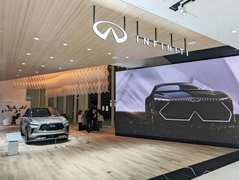
Even within the BMW portfolio, there is a degree of internal discussion about the brand’s current positioning. The head of the BMW National Dealer Forum recently expressed the view that a model along the lines of the Infiniti QX80, Cadillac Escalade, and Lincoln Navigator could perform exceptionally well in the U.S. market. This sentiment, coming from a representative of the dealership network—the group most directly in touch with customer desires and frustrations—carries significant weight. Dealerships are the front lines of the sales battle, and their feedback often shapes product strategy.
The potential name for such a vehicle, X9, has naturally emerged in online discussions and industry speculation. While BMW has historically used the “X” designation for its utility vehicles, the “9” would clearly delineate it as a product positioned above the existing X7, signifying a new tier of luxury and capability.
Engineering and Design Challenges
If BMW were to proceed with the development of an X9, it would face a series of complex engineering and design challenges. The first and most immediate hurdle is the decision regarding the underlying platform.
For the 2026 BMW X7, the automaker utilizes the CLAR (Cluster Architecture) platform, a scalable, flexible architecture that underpins much of the brand’s lineup, from the 7 Series sedan to the X5. This modularity allows for cost-effective production and efficient integration of new models. However, to accommodate the sheer size and weight requirements of a vehicle larger than the X7, BMW would likely need to significantly extend the CLAR platform or, alternatively, develop a dedicated architecture.
A more intriguing possibility, given the current industry trends, is the adoption of an electric-first or dedicated EV platform. The automotive landscape is rapidly shifting towards electrification, and for a new flagship model in 2026, bypassing electric propulsion entirely would be a bold, perhaps even anachronistic, decision. BMW has already demonstrated its expertise in high-performance EVs with the i4 and i7, and the i5 M60. An electric X9 could leverage this technology to deliver instant torque and silent, effortless acceleration, combined with a spacious, minimalist interior that capitalizes on the packaging advantages of an EV platform.
The